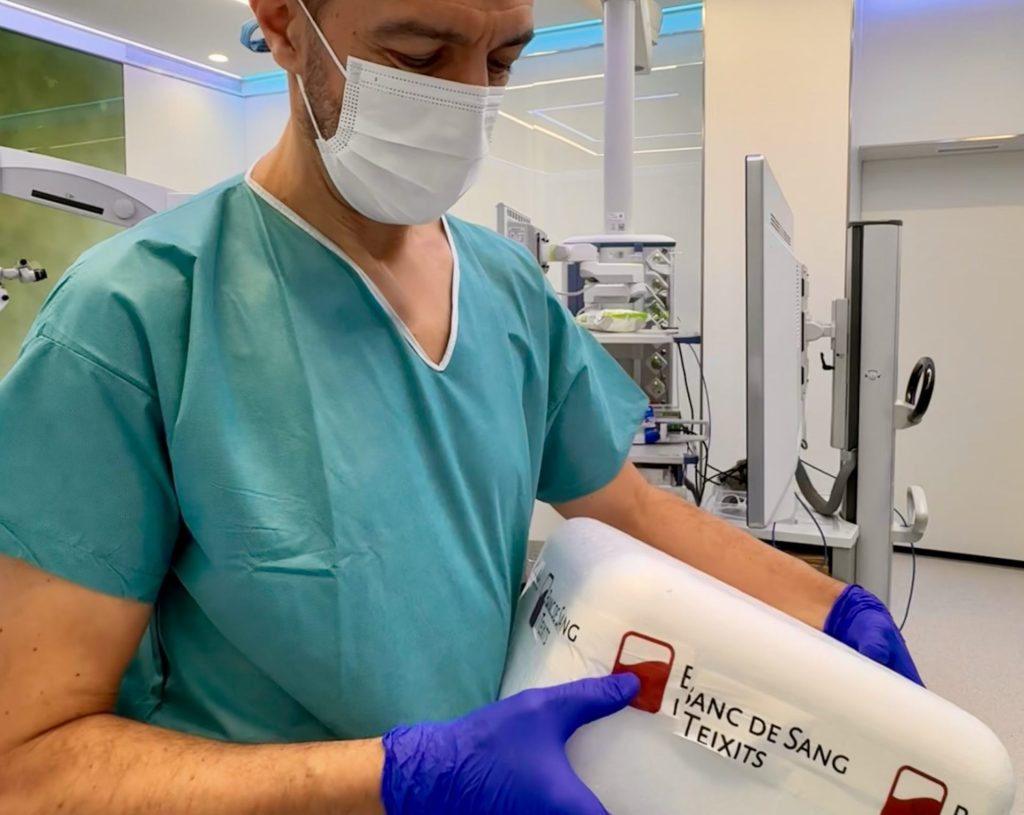
Many people still believe that all cornea transplants are the same. They are not. And this misconception can make the difference between a slow, complex recovery with higher risks… or a much faster and more precise outcome. Dr. Josep Torras, a cornea specialist ophthalmologist at Visionclinic, sees this every day in clinical practice: choosing the right technique directly impacts the patient’s quality of life from day one.
A common misconception with real consequences
The idea that all cornea transplants are equivalent is still widespread. However, modern ophthalmology offers very different surgical approaches, with significantly different recovery times and outcomes.
At Visionclinic, Dr. Josep Torras performs around 60 cornea transplants per year between Visionclinic and Hospital Clínic of Barcelona, using advanced techniques such as endothelial keratoplasty (DMEK).

Dr. Josep Torras
“Continuing to think that all cornea transplants are the same is not only a conceptual mistake, but it may prevent patients from accessing less invasive procedures with better visual outcomes and significantly faster recovery.”
What is endothelial cornea transplant (DMEK)?
Endothelial keratoplasty is an advanced technique that replaces only the damaged inner layer of the cornea (the endothelium), rather than the entire cornea.
It is especially important in common conditions such as Fuchs’ endothelial dystrophy, one of the leading indications for corneal transplantation.
Advantages over full-thickness transplants
Endothelial cornea transplantation offers clear advantages over traditional techniques:
– Only one stitch… or none
– Minimal incision
– Faster, more comfortable recovery
– Quicker visual improvement
In contrast, full cornea transplants may require up to 16 sutures, leading to longer recovery times.
Less invasive, more precise, better recovery
The difference between techniques is not only surgical, but also functional. It directly affects how and when the patient regains vision.
“Continuing to think that all cornea transplants are the same is not only a conceptual mistake, but it may prevent patients from accessing less invasive procedures with better visual outcomes and significantly faster recovery.”
Dr. Josep Torras
“Endothelial keratoplasty allows us to treat conditions such as Fuchs’ dystrophy much more precisely, replacing only the damaged part of the cornea and reducing both the surgical impact and the patient’s recovery time.”
The evolution of corneal surgery
Ophthalmology has advanced significantly in recent years, and cornea transplantation is a clear example of this. Current techniques allow for safer, more selective procedures with better outcomes.
The key is no longer just to operate, but to do so in the most appropriate way for each patient. Because when it comes to vision, not all options are the same. And choosing well makes all the difference.