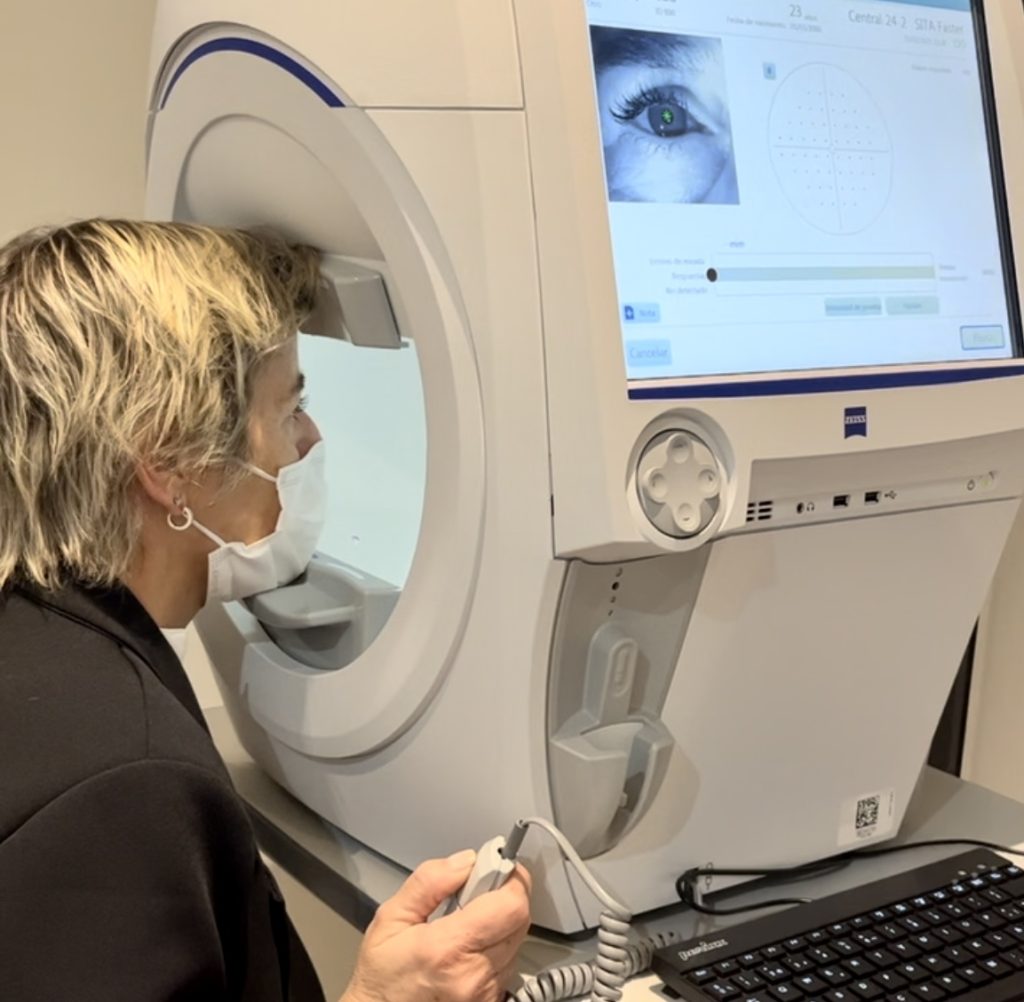
Visual field testing is one of the most important diagnostic tests in ophthalmology. It allows measurement of a patient’s visual field—that is, everything the eye can see, both directly in front and to the sides. It is a very simple test that helps detect possible problems or alterations affecting peripheral vision. Patricia Martín, optometrist at visiõnclínic, explains it to us.
What is the visual field?
The visual field is everything the eye can see, including what is directly in front (central vision) and what lies to the sides without the need to turn the head (lateral or peripheral vision). Central vision is always sharper and allows us to see more detail than peripheral vision, although both are essential for functioning normally.
How is visual field testing performed?

Patricia Martín
“The perimeter detects and records the stimuli that the patient is able to perceive and those they are not. In this way, it allows not only an initial diagnosis but also comparative follow-up to assess the progression of a condition”
What can visual field testing detect?
Detecting alterations in peripheral vision indicates that the patient may have an ophthalmological condition, even if they are not aware of it. Visual field testing can help detect glaucoma, certain diseases of the central nervous system, and some retinal pathologies.
Depending on the diagnosis, additional ophthalmic tests may be required, such as retinal photography, Optical Coherence Tomography (OCT), or a fundus examination. Like visual field testing, these are non-invasive procedures.

Dr Marta Pazos